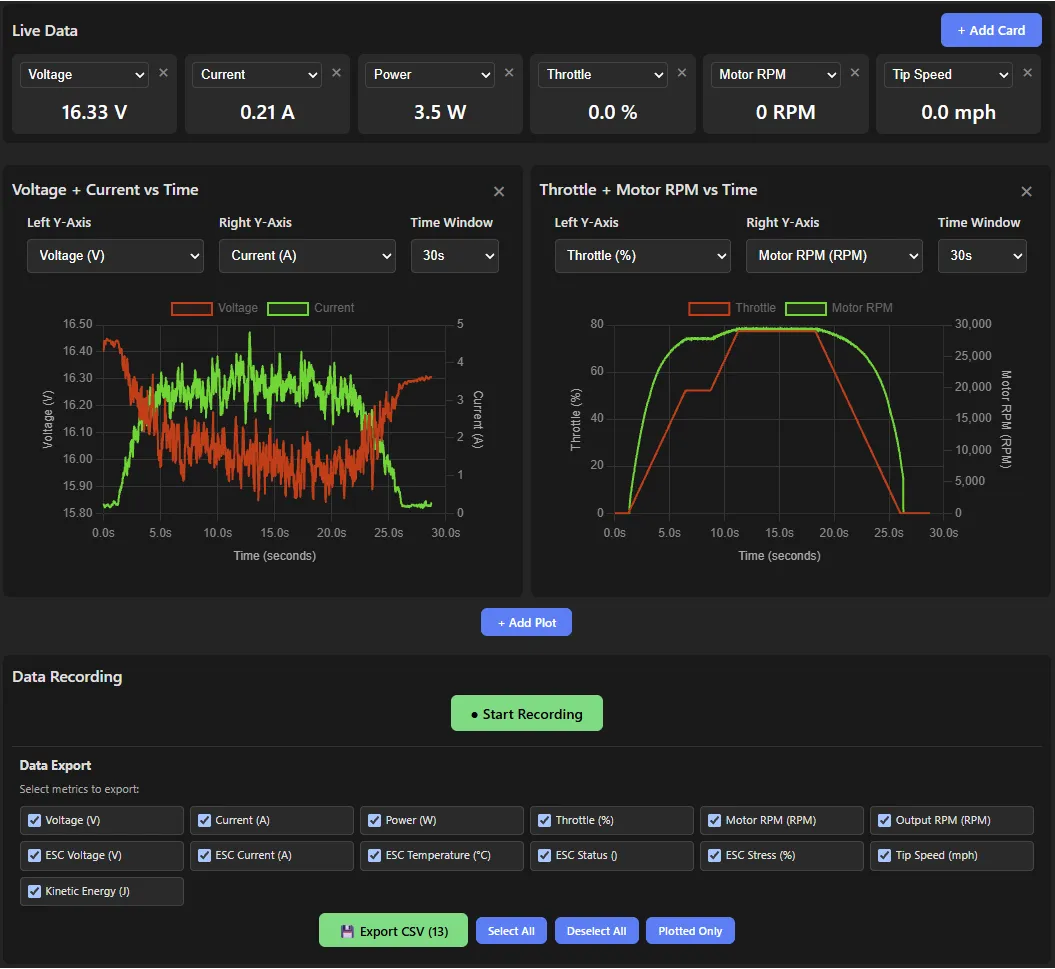
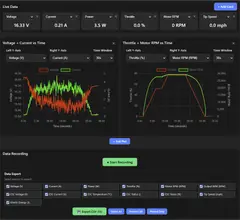
The web app allows the user to add data cards and live plots for a wide range of telemetry items
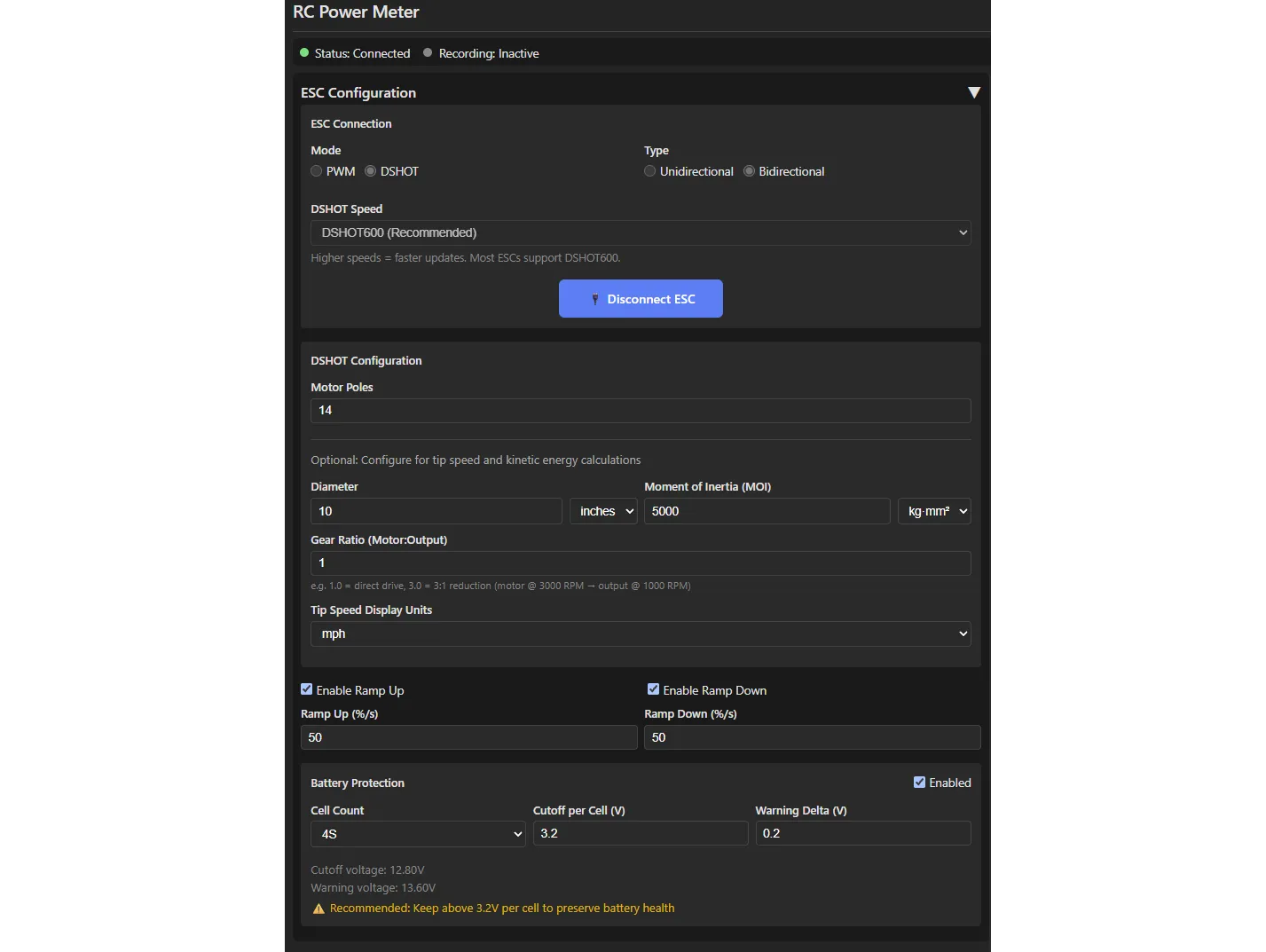
The web app also allows for configuring the ESC and control settings
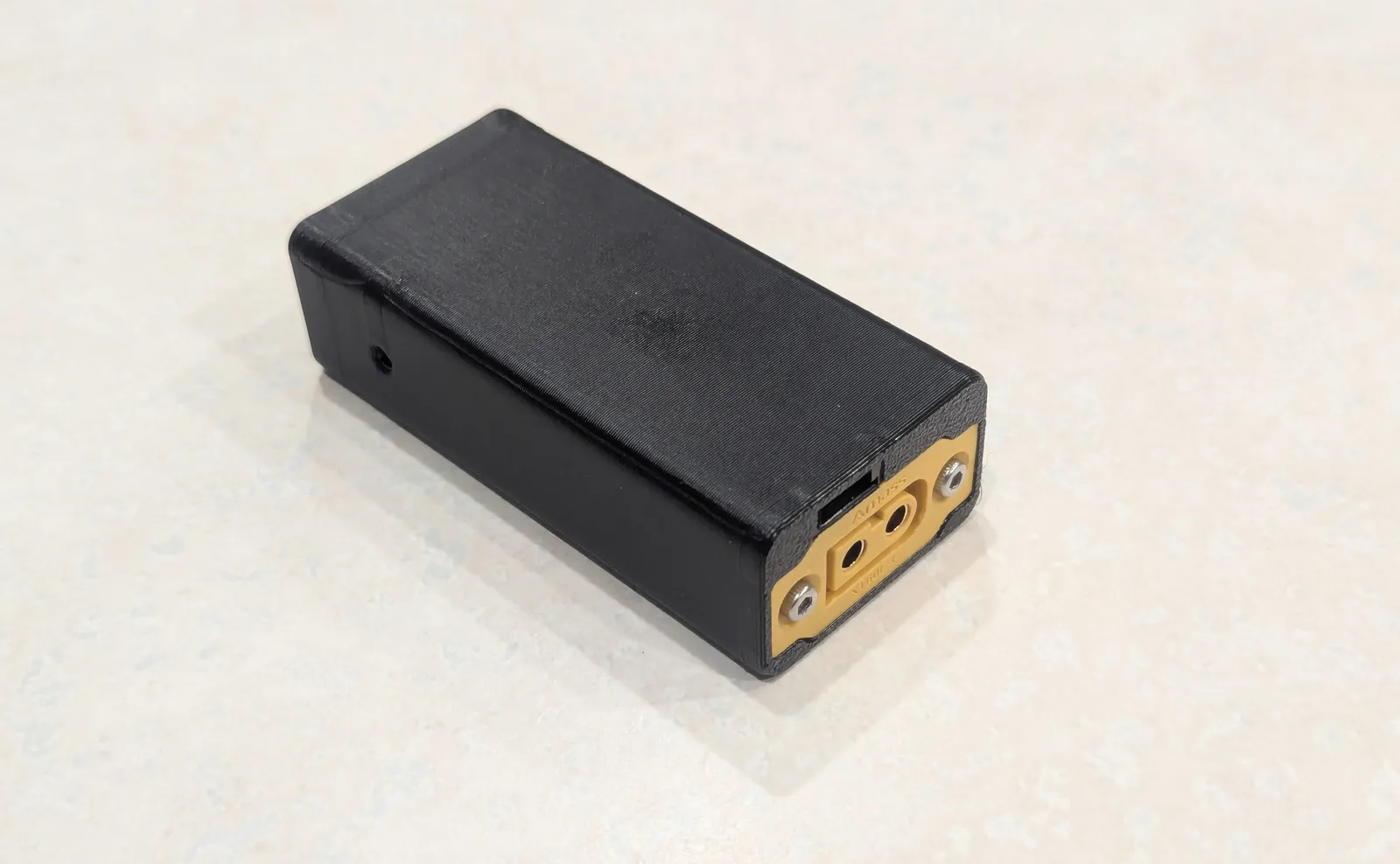
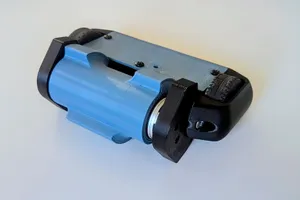
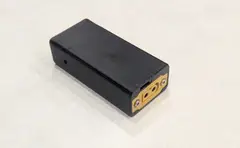
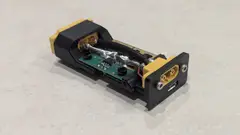
The Smart RC Power Meter prototype in a 3D printed case
Smart RC Power Meter
An RC power meter that measures voltage and current, and uses DSHOT to pull ESC telemetry, with motor control, live-plotting, and data logging using a web app
Quick Facts
Overview
This Smart RC Power Meter is designed to provide real-time telemetry and control for bench-testing RC vehicles. It measures voltage and current directly, and can control RC devices using PWM or DSHOT protocols. When using DSHOT with supported ESCs, it can pull telemetry data from supported ESCs, providing access to further information such as motor RPM, ESC temperature, and more. The device uses Bluetooth to communicate with a web app, providing ESC configuration, throttle control, live data plotting, and data logging.
This project arose from my experience using cheap RC power meters that measure voltage and current. These meters are inexpensive and simple, but they have no data logging, no plotting, and no way to control the ESC throttle. Most modern ESC’s also have internally tracked telemetry for voltage, current, temperature, and RPM estimation based on back-EMF (this RPM estimation is actually the basis for most sensorless motor control strategies, and the ESC relies on it to commutate correctly). I wanted a smarter solution that could access this information while providing real-time telemetry and data logging.
Development
Prototype 2
The second prototype of the Smart RC Power Meter will feature a custom PCB to integrate all the components into a single board, with an updated 3D printed case for protection and mounting
Before starting PCB design the main decision to make is whether to stick with the hall effect current sensor or switch to a shunt resistor. More research is needed to determine which option will provide the best combination of accuracy, efficiency, and cost for this application. Once that decision is made, the PCB design can begin, and the 3D printed case can be updated to accommodate the new board layout. I expect the largest challenge will be accommodating very large currents (up to 150A ideally) while keeping the board size and noise levels reasonably low.
Prototype 1
The first prototype of the Smart RC Power Meter, using a collection of COTS development boards and a 3D printed case
Quick Facts
Implemented Features
- Measures voltage and current from 6V to 60V and up to 150A continuous
- Uses bidirectional DSHOT to pull telemetry from ESC's that support it
- Battery low-voltage protection
- Motor throttle control (unidirectional or bidirectional)
- Auto-shutoff if the web app client is disconnected
- Live data card and plotting interface, with data logging to CSV
Prototype 1 with its 3D printed case
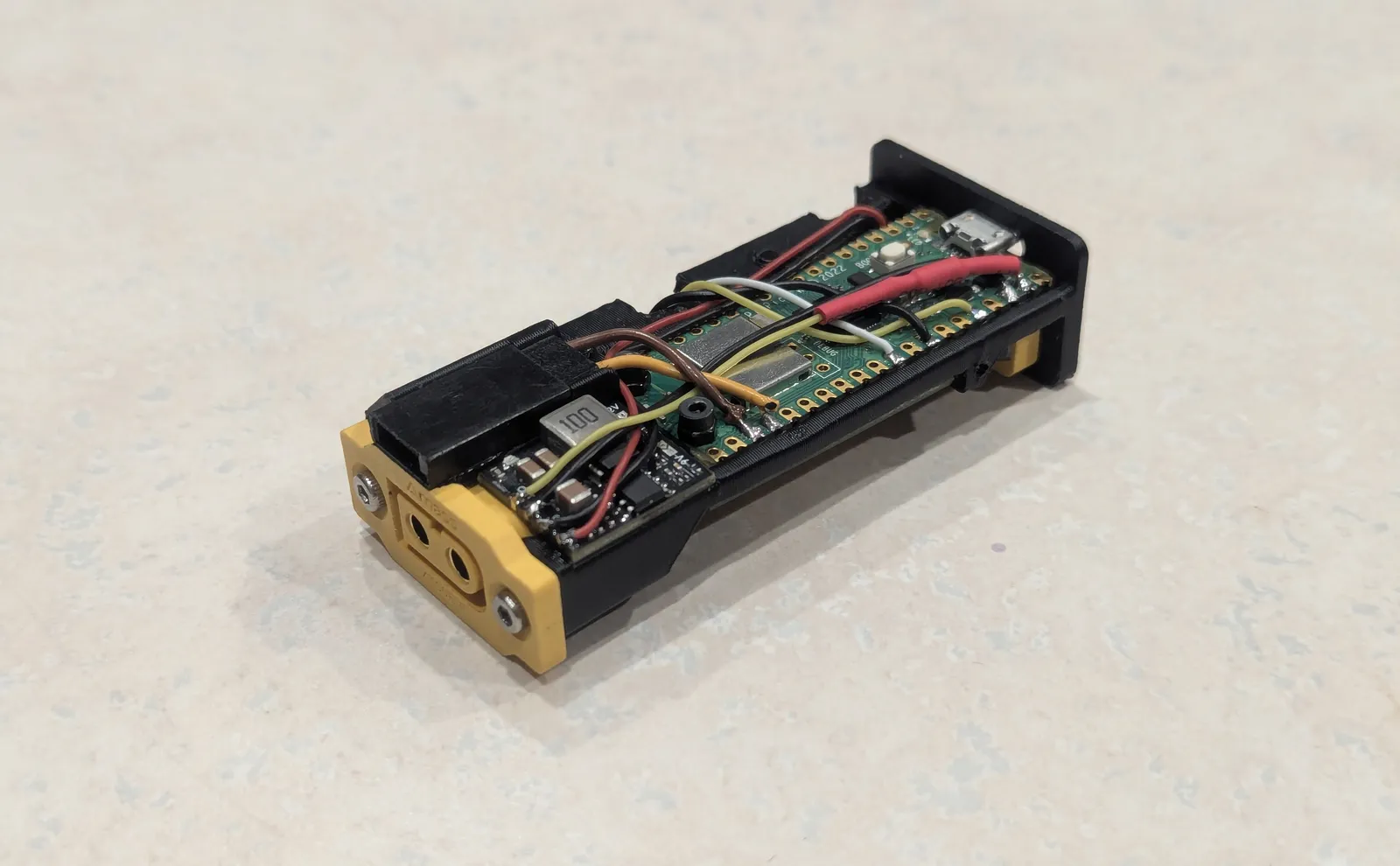
Front side of Prototype 1 without the outer case, showing the Raspberry Pi Pico W, buck converter, and servo connector on a 3D-printed sled
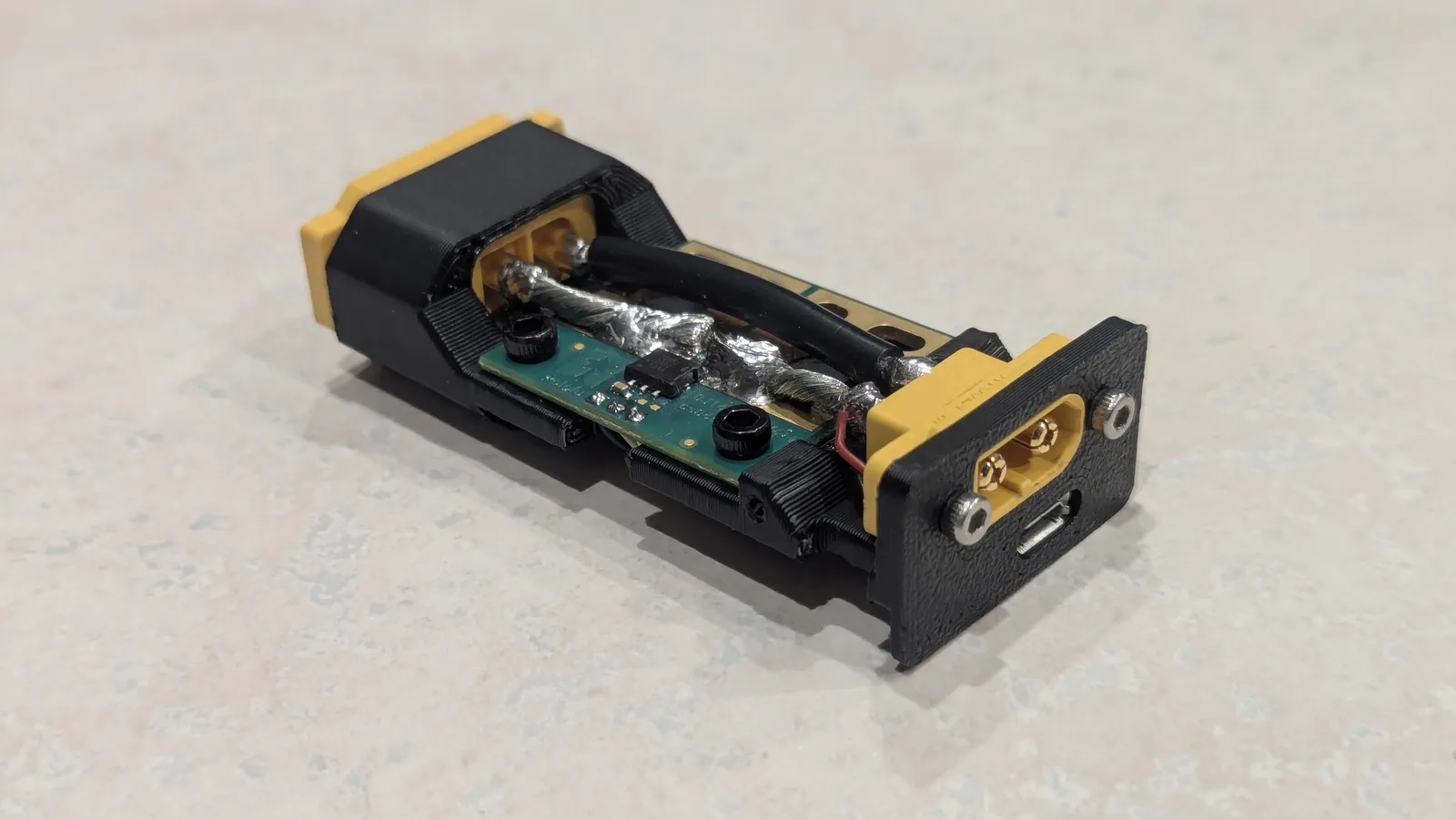
Reverse side of Prototype 1 without the outer case, showing the hall effect current sensor module, and the power connections between XT-60 connectors
Initial Feedback
Early feedback from the combat robotics community has been positive, and builders expressed that they generally want more insight into what their electronics are doing. The device can be used to measure the voltage sag that occurs when spinning up a large weapon, or monitor current draw near full throttle to estimate how large the bot's battery should be. It can also be used to approximate the real tip speed of a weapon using the DSHOT RPM telemetry. These were all appealing use-cases.
However, builders were also concerned about the size of the device, which effectively requires any testing to be done on a bench, with the robot's electronics exposed. If not secured properly, this could cause safety issues when operating a heavy or large weapon. It also can't be used to measure events in-situ, like what happens during large weapon impacts, etc. Some builders proposed more of a small "black box" design that could be installed inside the robot and log data during actual matches. Possible alternative designs:
- Smaller device that records to an SD card or local flash memory, and can be downloaded after the match like a black box
- Would have to sit between the RC radio receiver and the ESCs
- Same as above, but streams live data to a phone or laptop via Bluetooth
- Custom RC radio receiver that adds on the above functionality (either black-box or live-streaming)
The above ideas would require a very different direction, enough to be considered its own project. This project, therefore, will continue to focus on refining the current bench power meter concept.
Next Steps
- More robust DSHOT implementation
- Some ESC's handle arming and telemetry differently, so the code needs to be more robust to handle these differences
- Use logic analyzer to decode the signal and verify the timing
- Increase number of motor control outputs
- Decide between keeping the hall effect current sensor or switching to a shunt resistor
- Design a custom PCB to replace the dev boards, and make the device smaller and more robust