Balloon in an Accelerating Car
November 9, 2025
Introduction
I was recently part of an interview panel for a Mechanical Engineering intern position at my workplace, and toward the end of the interview, we asked a relatively well-known physics puzzle. The question goes something like this:
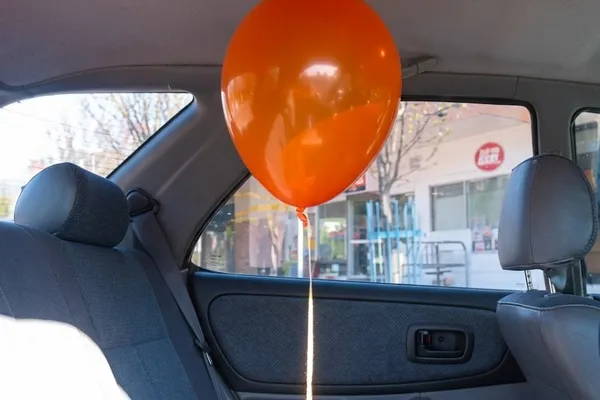
You are in the driver’s seat of a car, sitting at a red light with all of your windows rolled up. Floating next to you is a helium balloon. When the light turns green, you slam on the gas pedal and start accelerating. How does the balloon move?
In an interview setting, the point of questions like these is not whether the candidate arrives at the right answer. They are intended to draw out the thought process of the interviewee and give them a chance to demonstrate their problem-solving skills. A successful response should involve asking clarifying questions, talking through any assumptions being made, and showing a basic understanding of logical analysis and physics concepts. The interviewee could also propose methods for arriving at the right answer, even if they can’t conduct those methods in the moment (i.e. a set of equations to solve, simulations to run, or experiments to conduct).
However, this page is dedicated to the actual physics behind the proposed scenario. The correct answer to the question is that the balloon will move forward. This is because the acceleration of the car creates a horizontal pressure gradient in the enclosed air, and the less dense balloon is carried forward by buoyancy. Put another way, in the (non-inertial) reference frame of the car, there is an apparent force acting backwards on all the contents, including the air and the balloon. However, the buoyancy of the balloon results in a net forward force. This is mathematically equivalent to the reason that the balloon floats upward in the first place (gravitational force acting downward on everything, but the balloon’s buoyancy is greater than its weight).
I first came across this question in my high school physics class, and I definitely came to the wrong conclusion at the time. However, even when the right answer was explained to me, I was skeptical. Even today, around 10 years later, after judging intern candidates while knowing the correct answer, and having seen physical demonstrations proving the scenario, I have some lingering confusion about the underlying physics. Would the car’s magnitude of acceleration or the size of the balloon affect the answer? Does it matter if we consider the acceleration as instantaneous or increasing over time? Doesn’t the front-to-back pressure gradient take time to develop? This page is intended to settle the matter in my mind.
I think it’s safe to say that I’ve been nerd-sniped.
Assumptions
While studying this problem, we’ll make the following assumptions and simplifications:
- The car is accelerating in a straight line on a flat road.
- The car’s windows and vents are completely sealed, so there is no exchange of air with the outside environment.
- The air inside the car behaves like an ideal gas, and is initially uniformly distributed
- The balloon is inflated with enough helium to be vertically buoyant in the air inside the car
I initially included far more assumptions for other physical properties of the system, but I then found a simple argument that worked independently of all those properties.
Analysis
Let’s start by analyzing the horizontal forces acting on the balloon in the car’s reference frame. The balloon experiences a forward buoyant force, and a backward force due to its inertia (i.e. the apparent force in the non-inertial reference frame of the car). The net force on the balloon is:
Where:
- is the density of the air inside the car
- is the volume of the balloon
- is the acceleration of the car
- is the mass of the balloon (including the helium)
In this case, a positive net force would indicate that the balloon moves forwward.
The mass of the balloon includes both the mass of the helium and the mass of the latex. The mass of the latex is fixed, and the mass of the helium depends on the volume of the balloon and the density of the helium. However, this density also depends on the volume of the balloon and the elastic properties of the latex, because the surface tension in the latex affects the pressure of the helium inside the balloon.
Rather than trying to model these complex interactions, we’ll use Assumption 4, which requires that the balloon is inflated enough to be vertically buoyant in the air inside the car. This means that the vertical buoyant force on the balloon is greater than or equal to the balloon’s weight:
This places an upper bound on the mass of the balloon with respect to its volume. This makes sense, because for a given volume, the balloon can only be so heavy before it stops being buoyant. We can use this inequality to substitute in for the mass of the balloon in our previous expression, placing a lower bound on the net horizontal force:
Welp, that was anticlimactic. And here I thought I’d have to crack open a Jupyter Notebook, code some equations across a range of variables, and plot the results. The net horizontal force on the balloon is greater than or equal to zero, which means that the balloon will either stay in place or move forward. It cannot move backward. It’s interesting to note, however, that the balloon could theoretically stay in place if it is neutrally buoyant.
Importantly, this inequality holds regardless of the balloon’s volume, the car’s acceleration, or the time dependence of that acceleration. As long as the balloon is vertically buoyant, it will experience a net forward force when the car accelerates.
Caveat: Time for Pressure Gradient to Develop
Since we’re accelerating from rest, the internal air pressure gradient takes some time to develop. This pressure gradient will effectively develop at the speed of sound in air. When the car starts accelerating, the air near the back will start increasing in pressure, while the air near the front will start decreasing in pressure. These two effects will propagate through the air at the speed of sound, until they meet somewhere in the center of the car. During the time it takes for this pressure gradient to develop, the balloon will not experience any horizontal buoyancy, and will only see the backward inertial force.
We can calculate the time it takes for the pressure gradient to fully develop under the following assumptions:
- The car’s interior length (L) is 2 m
- The balloon starts at the midpoint of the car’s interior (to maximize the time it takes for the pressure gradient to reach it)
- The speed of sound in air is approximately 343 m/s
This means that in our best-case scenario, the balloon will experience a net backward force for about 3 milliseconds before the pressure gradient fully develops and the net forward force takes over. This is mildly interesting, but I would never expect someone to bring this up in an interview setting. It does, however, validate my intuition that the balloon could experience a brief backward motion at the very start of the acceleration, before moving forward. This motion would be completely imperceptible, but I’ll still claim that my initial skepticism to the “balloon moves forward” answer was somewhat justified (albeit in a very pedantic matter).
Conclusion
In the end, I am satisfied to conclude that the balloon will move forward when the car starts accelerating. The pressure gradient time delay is an interesting additional detail, and I’d give extra brownie points if someone brought it up during an interview, but I don’t think it’s the main point of the question, and it wouldn’t result in visible backward motion anyways.
I’m very glad I found a simple mathematical argument to prove the answer. At first, I was starting to get into the weeds of trying to calculate the mass of a balloon as a function of its volume, based on the helium pressure developed by the surface tension in the latex, and I was not looking forward to that rabbit hole. Taking a step back and using the vertical buoyancy constraint to consider the mass and volume of the balloon as a whole turned out to be a much more elegant solution. I hope this page is helpful to anyone else who has been confused by this question, and I also hope it serves as a good reminder to always take a step back and look for a simpler solution rather than over-complicating things.
For an experimental demonstration of this scenario, check out Smarter Every Day’s YouTube video on the topic: